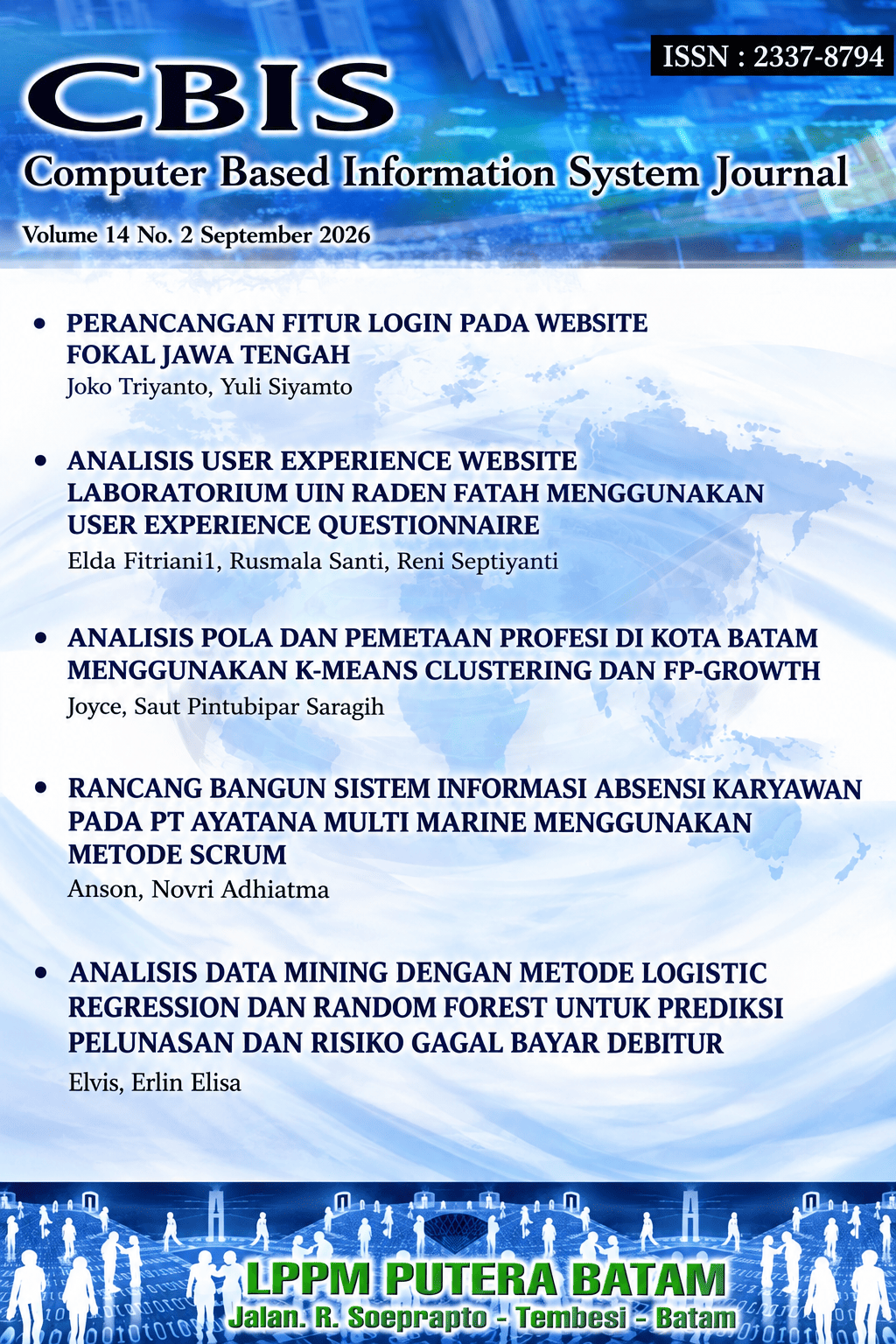
ANALISIS DATA MINING DENGAN METODE LOGISTIC REGRESSION DAN RANDOM FOREST UNTUK PREDIKSI PELUNASAN DAN RISIKO GAGAL BAYAR DEBITUR
DOI:
https://doi.org/10.33884/wd8awx46Keywords:
Credit Scoring, Data Mining, Default Risk, Logistic Regression, Random ForestAbstract
The financing sector in Indonesia faces increasing bad debt risks, particularly in motor vehicle financing. PT XYZ grapples with an 18.2% default rate due to subjective manual credit assessments. This study aims to compare Logistic Regression and Random Forest algorithms to predict creditworthiness using historical data from 2024-2025. The methodology involves data cleaning, transformation, and modeling, with performance evaluated via accuracy and Area Under Curve (AUC) metrics. Results indicate that Random Forest outperforms Logistic Regression, achieving an accuracy of 85% and an AUC of 0.914. It effectively distinguishes high-risk customers and minimizes false negatives, reducing the risk of rejecting eligible applicants. This research demonstrates that data mining, specifically Random Forest, offers a more objective and accurate solution for managing default risk in financing companies
Downloads
Published
Issue
Section
License
Copyright (c) 2026 Computer Based Information System Journal

This work is licensed under a Creative Commons Attribution-NonCommercial-ShareAlike 4.0 International License.